


Blog
The Rise of Virtual ADR: A Deep Dive into Its Strengths, Shortcomings, and Why GCAAM Is Prepared for Your Next Resolution

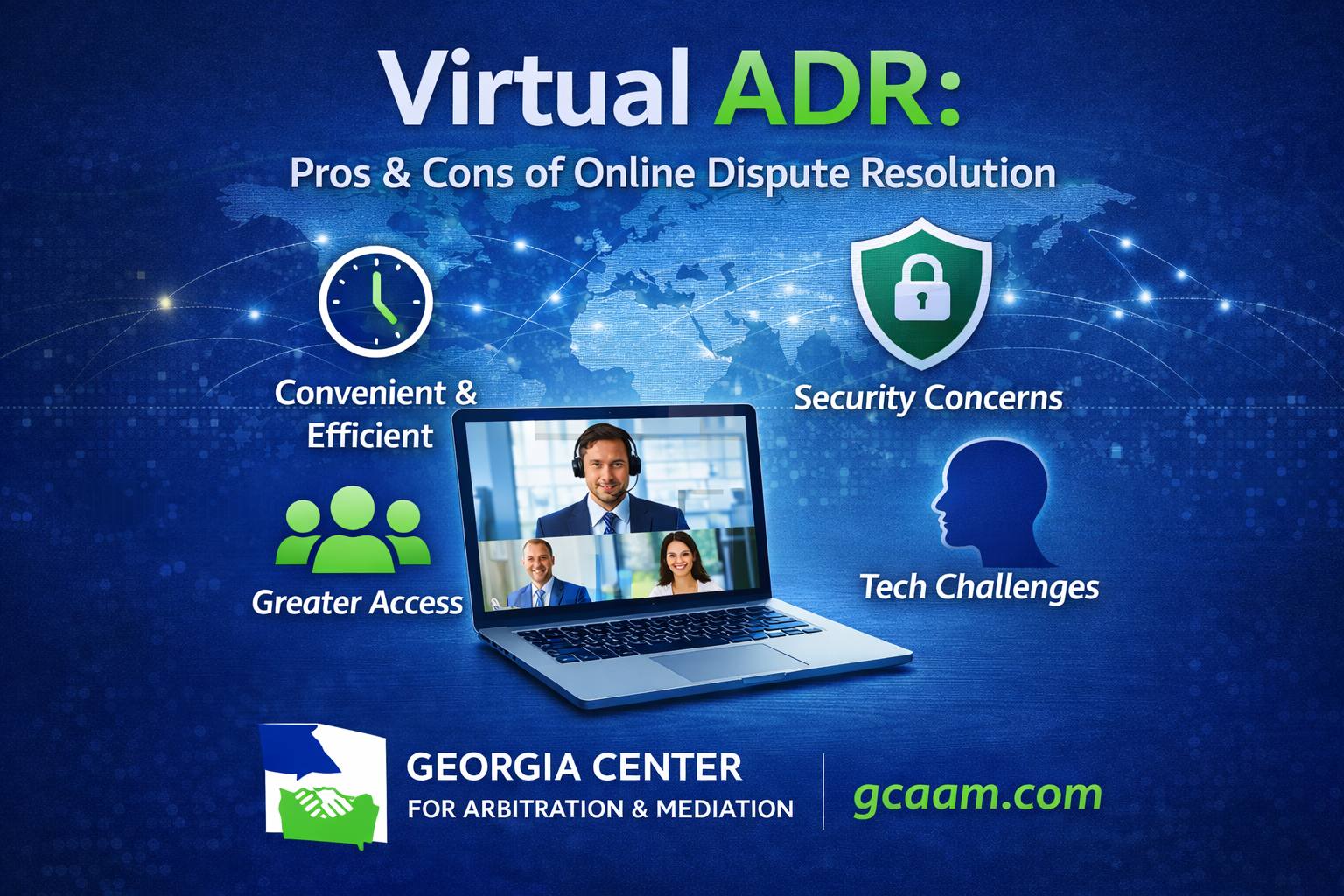
 Over the past few years, alternative dispute resolution (ADR) has experienced a dramatic shift. What was once almost exclusively done around a conference table has rapidly moved — and, in many respects, improved — into the digital space. Virtual ADR is no longer a workaround; it’s home base for many attorneys, corporations, and individuals seeking fair, efficient, and equitable outcomes without the expense and delay of traditional litigation.
As a registered mediator in Georgia and part of the professional team at the Georgia Center for Arbitration & Mediation (GCAAM), I’ve observed first-hand how virtual ADR has reshaped the dispute resolution landscape. In this deep dive, we explore the advantages and disadvantages of virtual ADR, while offering practical insights for those considering a virtual mediation.
What Is Virtual ADR?
Virtual ADR refers to mediation and arbitration conducted through video conferencing and online communication platforms instead of in-person meetings. Much like telemedicine revolutionized healthcare access, virtual ADR democratizes access to dispute resolution — and it’s here to stay. At GCAAM, our neutrals are trained to used our communication platforms and software to ensure that the participated have as positive an experience with virtual mediation as possible. We have successfully used virtual mediation and virtual arbitration to economically and conveniently resolve legal issues for the participants.
Advantages of Virtual Mediation & Virtual Arbitration
1. Expanded Access & Greater Flexibility
Virtual ADR removes geographic barriers. Parties can participate from anywhere — whether it’s across town, across the state, or across the country. That means better participation for clients, counsel, and experts without the burden of travel. At GCAAM, we regularly conduct virtual sessions with participants throughout Georgia, the Southeast, and nationally. Since our neutrals are subject-area experts, their problem-solving skills and knowledge are sought out nationally. Online mediation and Onine arbitration ensuring everyone has a seat at the table conveniently.
Why this matters:
- Reduced logistical friction
- Broader availability of top-tier neutrals
- Scheduling that works around client and counsel availability
2. Time and Cost Savings
Time is one of the most precious assets for any dispute resolution process. For litigators juggling full dockets, in-person ADR often means rearranging calendars — and absorbing billable hours in travel time. Virtual ADR eliminates that.
Benefits include:
- No travel costs
- No time wasted in transit
- No traffic!
- Quicker turnaround from scheduling to resolution
- You don’t have to pack us documents for use in the live ADR
For small business owners or individuals, this cost-efficiency can make ADR a meaningful option — not just a theoretical one.
3. Comfort & Reduced Stress
Let’s be honest: walking into a boardroom with opposing counsel and parties can be intimidating. Virtual ADR allows participants to join from familiar surroundings, which can reduce anxiety and promote candid conversation — often leading to more productive negotiations. Neutrals at GCAAM are trained to create space for comfortable, respectful engagement virtually, just as effectively as we do in person.
4. Enhanced Recordkeeping & Technology Tools
Virtual platforms often make it easier to share documents, display exhibits, and record sessions where appropriate. Many systems have built-in features for private breakout sessions, secure document exchange, and real-time collaborative editing. This can make the process smoother, particularly in complex cases where documents or visuals play a key role.
Disadvantages of Virtual ADR
While virtual ADR boasts compelling advantages, it’s not without challenges. Awareness of these potential drawbacks helps participants prepare better and lets neutrals tailor the process to each unique case.
1. Technology Barriers
Not every participant has reliable internet access, a quiet space, or up-to-date hardware. Technical difficulties can interrupt proceedings and, if unmanaged, may frustrate participants.
Mitigation: GCAAM offers pre-session technical orientation and support so parties can enter the mediation confident and prepared — not stressed about a frozen screen.
2. Limited Non-Verbal Communication
In-person interactions provide cues — posture, subtle gestures, energy shifts — that sometimes don’t fully carry over on video. Skilled mediators can read many of these cues virtually, but the depth of in-person interaction can be harder to replicate.
What’s the solution? Experienced neutrals adapt. At GCAAM, our training equips us to optimize virtual engagement, while recognizing when an in-person session may better serve a particular dispute.
3. Perceived Formality & Commitment
Some parties underestimate the importance of virtual ADR, assuming that because it’s “online” it’s less serious. This can impact preparation, participation, and engagement.
At GCAAM, we set clear expectations and provide guidance so that virtual ADR is respected as a robust, purposeful, and effective resolution process.
4. Confidentiality & Security Concerns
Virtual platforms have come a long way in terms of security, but parties frequently ask about confidentiality and data protection.
Good news: GCAAM uses secure, encrypted platforms and follows best practices to protect privacy. We also guide parties on how to maintain confidentiality on their end.
Is Virtual ADR Right for Your Mediation or Arbitration?
There isn’t a one-size-fits-all answer. But if you value convenience, flexibility, and efficiency, and you want your mediation to proceed without unnecessary delays, then virtual ADR is often an excellent choice — particularly when facilitated by experienced neutrals who understand both technology and human dynamics.
Whether you’re handling:
• commercial disputes
• employment matters
• contract negotiation breakdowns
• family or domestic relations issues
• or any matter where parties want to remain in control of outcomes
…virtual ADR offers a path that’s accessible, efficient, and effective.
At GCAAM, we help you discern the best format for your matter — virtual, in-person, or hybrid — and we guide you through every step of the process.
Final Thought: The Future of ADR Is Flexible
Virtual ADR isn’t a trend. It’s an evolution — one that promotes equity, efficiency, and client-centered resolution. It allows high-quality neutrals to connect with parties regardless of physical boundaries, and it empowers participants to engage with less stress and more focus on resolution.
And no matter where you’re located — here in Georgia or beyond — GCAAM’s roster of experienced, registered mediators is ready to guide you through virtual ADR with skill, care, and professionalism.
Visit gcaam.com to learn more about how we can support your virtual mediation needs or contact us here > >