Blog
When Winning a Lawsuit Is a Bad Business Decision: The Economics of Commercial Mediation

by Mark A. Cobb

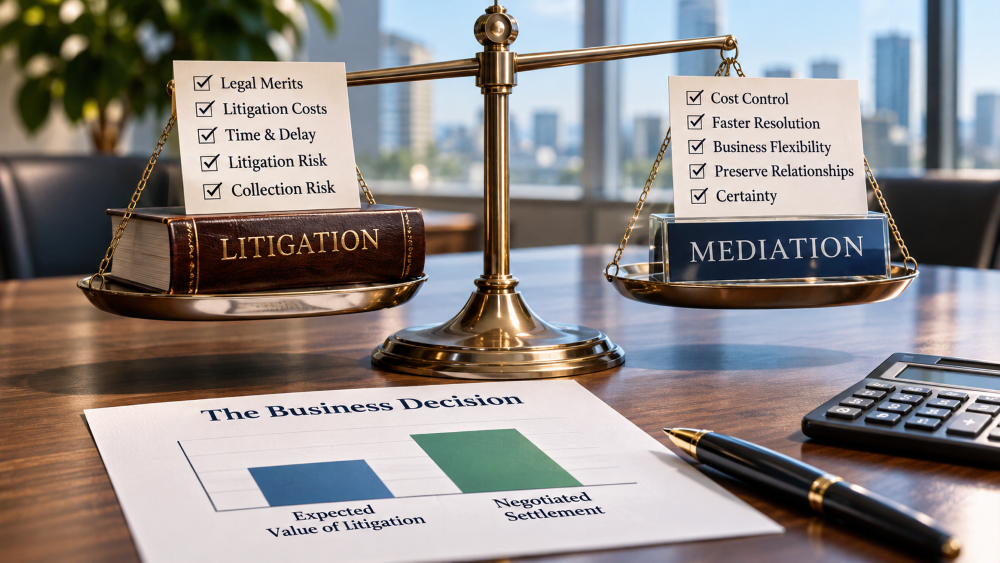
Winning a lawsuit is not always the best business decision. Commercial mediation allows businesses to weigh litigation risks against the economic benefits of a negotiated settlement.
One of the more difficult conversations a commercial litigator has with a client occurs when the lawyer believes the client has a sound case but cannot recommend taking it to trial. There may be little disagreement about the merits of the claim. The contract may be unambiguous, the documentary evidence compelling, and the applicable law favorable. Nevertheless, the financial consequences of pursuing a judgment may render continued litigation inadvisable.
For counsel representing a business, the question is not simply whether the client is entitled to recover. It is whether the anticipated recovery justifies the expenditure of corporate resources necessary to obtain it. That distinction has particular significance in construction disputes, commercial lending matters, shareholder controversies, and litigation arising out of substantial contractual relationships.
Commercial mediation affords counsel and their clients an opportunity to examine the economics of a dispute without abandoning their legal positions. It is an exercise that deserves considerably more attention than it sometimes receives.
Legal success and commercial success
Consider the respective perspectives of trial counsel and a company’s chief financial officer. Counsel may be concerned with the admissibility of a particular document or the enforceability of a contractual limitation of liability. The CFO, quite properly, may be more concerned with whether the company can finance its next expansion while the disputed receivable remains outstanding. Neither perspective is wrong, but both belong in the settlement analysis.
A judgment establishes a legal entitlement. It does not necessarily produce an immediate economic benefit. Counsel must still consider the possibility of an appeal, the availability of assets against which to execute, competing creditors, and the expense of enforcement. A judgment against a company that subsequently seeks bankruptcy protection may be of considerably less value than counsel anticipated when drafting the complaint.
A judgment establishes a legal entitlement. It does not necessarily produce an immediate economic benefit.
What does commercial litigation actually cost?
Attorneys’ fees are the obvious starting point. Under the American Rule, a prevailing party generally cannot expect to recover its fees absent a contractual provision, statutory authority, or other recognized exception. In Georgia, O.C.G.A. § 13-6-11 authorizes an award of litigation expenses under specified circumstances. The existence of a meritorious contract claim, standing alone, does not establish entitlement to such an award. Even where a claim for fees is well founded, counsel must account for the uncertainty of recovery.
The cost of expert testimony can be particularly pronounced in commercial litigation. A construction delay claim may require a scheduling consultant and an engineer; litigation involving the purchase of a business may necessitate the services of a forensic accountant and a valuation expert. Electronic discovery, depositions, and document review add further expense. A substantial portion of these expenditures may be incurred before the parties know whether the matter will survive summary judgment.
Less apparent are the costs that do not appear on counsel’s invoice. A project executive who spends a week preparing for deposition is not supervising current projects or negotiating new contracts. A controller who devotes several months to reconstructing transactions for a forensic accountant has fewer resources available for the ordinary financial affairs of the business. The smaller the enterprise, the greater the potential disruption.
Pending litigation may also affect transactions entirely unrelated to the dispute. A contractor facing substantial claims may encounter additional scrutiny from its surety. A borrower may be required to explain contingent liabilities to its lender. A prospective purchaser of a business may insist upon a reduction in the purchase price or a substantial escrow to account for unresolved litigation. These consequences warrant consideration even though they may never appear in a damages calculation.
The present value of a prospective judgment
Lawyers who regularly handle commercial collections appreciate that the amount of a judgment and its value are different propositions. The same distinction should inform settlement negotiations well before trial.
Capital received today can be used to retire debt, purchase equipment, or finance operations. Capital that may be received three years hence cannot. Although prejudgment and postjudgment interest may offset some of the consequences of delay, the statutory or contractual rate may bear little relationship to the client’s actual cost of capital.
Consider a hypothetical breach of contract action in which the plaintiff seeks $1 million. Counsel estimates a 75 percent probability of recovering the entire amount and, conditional upon obtaining that judgment, a 90 percent probability of collecting it in full. Assume that collection will occur three years from now, that remaining litigation and enforcement expenses have a present value of $200,000, and that the client uses an 8 percent annual discount rate reflecting the time value of money. The defendant offers $550,000, payable immediately.
The following simplified calculation illustrates why accepting that offer may be the better business decision.
| Economic consideration | Amount |
| Potential judgment | $1,000,000 |
| Probability-adjusted recovery (75% × 90%) | $675,000 |
| Present value of recovery ($675,000 ÷ 1.08³) | $535,837 |
| Remaining litigation expenses (present value) | ($200,000) |
| Net present value of continued litigation | $335,837 |
| Immediate settlement | $550,000 |
| Economic advantage of settlement | $214,163 |
The calculation assumes full recovery or no recovery, treats remaining expenses as payable in either outcome, and disregards taxes, interest awards, fee shifting, settlement implementation costs, and partial recoveries. Actual litigation rarely lends itself to such a binary model. Counsel should ordinarily evaluate several possible outcomes, including partial judgments and counterclaim exposure. The discount rate and probabilities should also be tested against alternative assumptions rather than treated as established facts.
Nevertheless, the example is instructive. Even if the client were certain to prevail and collect the full judgment in three years, its net present value after the assumed expenses would be approximately $593,832. The $550,000 offer would then be only about $44,000 less valuable than the best modeled litigation outcome. A client might reasonably regard that difference as an acceptable price for certainty.
The relevant comparison at mediation is between the alternatives available at that time. Fees already incurred are generally sunk costs; they should not, merely because they have been incurred, justify rejecting a commercially reasonable offer. They may, however, remain relevant to a recoverable fee claim. This is one reason why the timing of mediation deserves careful consideration.
The defendant’s economic analysis
Defense counsel faces a similar calculation. A company with persuasive defenses may spend considerable sums establishing that it owes nothing. Absent a basis for shifting those expenses, a successful defense does not restore the resources expended in obtaining it.
In a multiparty construction dispute, a general contractor may have a defensible claim against its subcontractor but remain exposed to related claims by the owner, other trades, and suppliers. Indemnity obligations and insurance coverage disputes may further complicate the matter. Prevailing in one proceeding may do little to resolve the others.
Where the interested parties can participate, mediation may allow counsel to negotiate interdependent releases, allocate payments among responsible entities, and address outstanding project obligations. A comprehensive resolution may have a value to the client that cannot be measured by reference to the complaint in any single action.
Relief that a judgment may not provide
Commercial controversies frequently arise between parties whose interests remain intertwined. A manufacturer may depend upon the distribution network of the company it has sued. A lender may obtain a better recovery by restructuring a troubled loan than by liquidating its collateral. A developer may have a more immediate interest in completing a project than in determining responsibility for every disputed change order.
Although courts possess equitable powers in appropriate cases, they cannot ordinarily compel the parties to enter into a new commercial arrangement simply because it would be economically advantageous. Mediation allows the parties to negotiate terms that go beyond the remedies available in the pending action.
For example, a dispute over an unpaid commercial obligation might be resolved through an initial payment, a secured installment obligation, and a modification of future purchasing terms. A construction dispute might involve an agreed scope of corrective work, revised completion milestones, and coordinated releases. In a shareholder controversy, a negotiated buyout may permit the enterprise to continue operating without the distraction of prolonged litigation.
The face value of a claim is rarely the same as its commercial value.
Such arrangements require careful drafting. Counsel must evaluate security, priority, default remedies, necessary third-party consents, and whether releases should become effective upon execution or performance. Confidentiality also requires attention to the governing law and agreement; the Georgia Office of Dispute Resolution’s rules and related statutory resources provide a useful starting point.
Selecting a mediator for a complex commercial matter
The choice of creative, useful neutral deserves particular attention when a dispute involves specialized legal or financial issues. A mediator familiar with construction scheduling, retainage, and payment bonds may be able to engage counsel in a more productive discussion of a construction claim. Similarly, familiarity with loan covenants, guaranties, collateral, and business valuation can be useful in a commercial finance dispute.
The mediator need not resolve competing expert opinions or render a view on every contested legal question. Rather, the benefit of relevant experience lies in the ability to understand the parties’ positions, identify assumptions that merit further examination, and facilitate consideration of workable settlement terms. Counsel may also find useful the discussion of negotiation approaches in GCAAM’s article on breaking a mediation impasse.
Preparing the client for a commercial mediation
Before the mediation, counsel should prepare a prospective litigation budget and discuss it with the person who actually bears responsibility for the company’s finances. Counsel should also evaluate the range of potential judgments, collectability, counterclaims, and the consequences of an appeal. A conversation with the CFO or controller may reveal financing restrictions, liquidity requirements, or other considerations that materially affect the client’s settlement authority.
Where appropriate, exchange the financial or technical information necessary for informed negotiations before the session. A mediation is unlikely to accomplish much if the parties arrive with fundamentally different damages calculations and neither has had an opportunity to examine the other’s methodology. Conversely, completing every conceivable deposition before discussing settlement may unnecessarily diminish the value of the available compromise.
Preserve applicable filing deadlines, limitation periods, lien rights, and other remedies while negotiations proceed. The decision to mediate does not, by itself, suspend those obligations.
When litigation remains the better alternative
There are circumstances in which settlement is neither practical nor desirable. A business may require immediate injunctive relief, a binding interpretation of a contractual provision affecting numerous transactions, or judicial assistance in protecting assets. A proposed compromise may simply undervalue the claim. Commercial considerations may also favor establishing a precedent or enforcing a contractual right rather than encouraging similar disputes.
Mediation is not a reason to recommend an inadequate settlement. It provides an opportunity to compare the available resolution with the alternatives. If that comparison favors litigation, counsel should be prepared to proceed.
Commercial mediation in Georgia
The Georgia Office of Dispute Resolution describes the state’s court-connected ADR framework and its role in providing alternatives to trial. Private mediation also affords businesses the opportunity to address disputes before litigation becomes necessary, or at an appropriate stage of a pending proceeding.
The Georgia Center for Arbitration & Mediation (GCAAM) offers commercial mediation and arbitration throughout Georgia. With offices in Atlanta and Thomasville, virtual services, and neutrals with experience in business, contract, construction, real estate, and financial matters, GCAAM assists counsel seeking to resolve sophisticated commercial disputes.
For attorneys advising commercial clients, the ultimate inquiry is seldom confined to whether the client can win at trial. It is whether obtaining that result represents the best available use of the client’s resources. In a surprising number of commercial disputes, those questions yield different answers.
If you have further questions, please feel free to contact the author at 404-446-0575 or use our convenient contact form.
Reviewed by Mark Cobb, attorney and GCAAM neutral. General information, not legal advice.