


Blog
Beyond Being Right: Understanding People, Perspectives, and the Art of Resolution

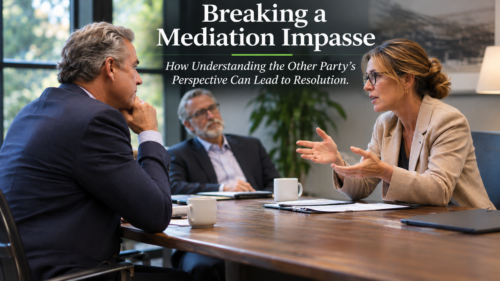
The first in a three-part series by George W. Thames

Understanding the other party’s perspective can help overcome a negotiation impasse and open new possibilities for resolution.
In most disputes, each party believes its position is justified. The facts support its arguments, its expectations are reasonable, and fairness demands a particular outcome. Yet, if both parties are so certain they are right, why do so many disputes prove difficult to resolve? Mediation impasse often lies beyond the facts and legal arguments. People bring their own experiences, values, expectations, and perceptions of fairness to every disagreement. These influences shape not only what they want, but also how they interpret the actions and motivations of others. Two people can examine the same circumstances and reach entirely different conclusions about what is fair or reasonable.
In this three-part series, Beyond Being Right, we will examine the human dimensions of conflict and the obstacles they create in negotiations. We will consider why parties become entrenched in their positions, how differing perspectives influence their willingness to compromise, and why understanding another person’s motivations can be more productive than simply proving that person wrong. Throughout the series, we will explore how these principles apply to mediation and the broader process of resolving disputes.
We begin with a familiar problem: What happens when negotiations reach an impasse, and neither party seems willing to move?
So, You’ve Reached an Impasse. Now What?
When understanding the other party’s worldview may be the key to finding a path forward.
We have all been there. A disagreement has gone on longer than anyone anticipated. Conversations have become repetitive. Offers and counteroffers seem to move neither side any closer to an agreement. Each party believes the other is being unreasonable, and what once seemed like a resolvable conflict has become a standoff. You have reached an impasse. Now what?
One of the most important, yet frequently overlooked, steps in resolving a conflict is understanding not just what the other party wants, but how the other party views the world. We all approach conflict with a set of assumptions, values, experiences, and expectations. Those influences shape what we consider fair, what we consider reasonable, and ultimately, what we believe a successful resolution should look like. And those worldviews are not always compatible.
Why Negotiations Reach an Impasse
Consider two very different approaches to resolving a dispute.
One person may approach the negotiation with the concept of charis in mind. Charis is an ancient Greek word associated with grace, favor, kindness, generosity, and goodwill. It suggests that there can be value in extending something beyond what is strictly required, recognizing the humanity of the other person, and finding a resolution that allows both parties to move forward.
The other person may approach the same negotiation in the spirit of agon, an ancient Greek term associated with competition and struggle. Taken to its extreme, this approach treats negotiation as a contest that must be won: Get every last dollar. Give nothing away. Leave nothing on the table.
Neither party may fully appreciate that the other is operating from a fundamentally different set of beliefs. The person who values charis may interpret the other party’s position as unnecessarily aggressive, vindictive, or unreasonable. Conversely, someone who believes negotiation is about extracting maximum value, regardless of the time involved, may interpret generosity as weakness or, with condescension, as an unwillingness to protect one’s interests.
And so, the impasse deepens.
Understanding the Other Party’s Perspective
Understanding the other party’s worldview does not mean you must adopt it. It does not mean abandoning your position, compromising your principles, or accepting less than you believe is appropriate. It means recognizing that the other party may be approaching the dispute from a different starting point.
Perhaps that party believes that making a concession will establish a dangerous precedent. Perhaps they believe that anything less than a complete victory represents a loss. Perhaps past experiences have taught them that trust is misplaced and that the only way to protect themselves is to negotiate aggressively. Or perhaps they simply have a different understanding of what fairness looks like.
Once you begin to understand those underlying perspectives, you can stop responding exclusively to the other party’s demands and begin addressing the concerns driving those demands. That can change the conversation.
How to Break a Negotiation Deadlock
When negotiations reach an impasse, parties often become consumed with the question: “What do I have to give up to get this resolved?” A more productive question might be: “What does the other party need to believe, understand, or receive in order to consider resolution acceptable?”
That question shifts the focus from positions to motivations. It may reveal that what appears to be a disagreement over money is actually a disagreement over recognition, respect, accountability, security, or control. And sometimes, it reveals that the parties are not nearly as far apart as their negotiating positions suggest.
For additional discussion of negotiation in mediation, see Expectations and Negotiation Throughout Mediation.
How a Mediator Can Help Resolve an Impasse
This is one reason mediation can be so valuable.
A mediator can help parties step outside the immediate demands of the negotiation and examine the perspectives that brought them to the table. By asking different questions, reframing conversations, and helping each side hear what the other is actually communicating, a mediator can sometimes uncover possibilities that the parties could not see on their own.
Mediation cannot guarantee an agreement, but it can provide a structured opportunity to explore alternatives that adversarial negotiations may have overlooked.
The goal is not necessarily to make everyone happy. Nor is it to persuade one party to surrender its values in favor of the other’s. The goal is to create an opportunity for the parties to find a resolution that makes sense within the realities of their dispute. Sometimes that requires compromise. Sometimes it requires creativity. And sometimes it requires recognizing that the desire to win at all costs carries its own costs.
Learn more about GCAAM mediation services and how an Atlanta mediator discusses the mediation process. An Atlanta mediator discusses the mediation process, including how parties can address obstacles to settlement.
Five Questions to Ask Before Abandoning Negotiations
If you find yourself at an impasse, consider taking a step back.
Ask yourself:
- What does a fair and reasonable resolution look like to me, and why?
- What assumptions am I making about the other party?
- What might the other party believe is at stake?
- Am I trying to resolve the conflict, or am I trying to win the argument?
- Is there room for a resolution that protects my interests without requiring the other party to feel completely defeated?
You may not agree with the other party’s worldview. You may not even like it. But understanding it may be the first step toward finding common ground. After all, resolution does not always require agreement about the past, the underlying conflict, or even what each party believes is right. Sometimes it simply requires finding a way forward. And that may be the most valuable outcome of all.
Conflict resolution requires understanding human nature, not just understanding the law.
Further Reading
The Oxford Classical Dictionary provides background on agon and its association with contest and competition.
The Harvard Program on Negotiation offers additional resources on negotiation and conflict resolution.
GCAAM also offers online mediation services for parties who cannot meet in person.
For more information, contact the Georgia Center for Arbitration & Mediation at [email protected] or visit our contact page.
Contact GCAAM to learn more about mediation services.
Reviewed by Mark Cobb, attorney and GCAAM neutral. General information, not legal advice.