


Blog
When Is the Best Time to Mediate a Dispute? Why Timing Matters

By Michael Ledyard | Georgia Center for Arbitration & Mediation

The timing of mediation can influence litigation costs, settlement opportunities, and the ultimate resolution of a dispute.
Experienced trial lawyers seldom agree on the best time to mediate a dispute. Some favor mediation before litigation begins. Others insist that meaningful negotiations require substantial discovery. Still others wait until trial approaches, when mounting expenses and the prospect of an uncertain verdict encourage compromise.
Each position has merit. The nature of the dispute, the available evidence, and the parties’ objectives should determine the timing.
Nevertheless, attorneys sometimes give this decision less attention than it deserves. They schedule mediation because a court requires it, discovery has concluded, or trial is approaching. Although these considerations matter, they should not dictate the litigation strategy.
In most cases, the parties should mediate once they possess enough information to evaluate their positions, but before litigation consumes resources that settlement could preserve.
The American Bar Association has examined this dilemma. In his article, When Is the Season for Mediation?, Joseph P. Esposito discusses the relationship between litigation expenses and the information parties acquire as a case progresses. The dilemma is straightforward: as litigation progresses, the parties generally acquire more information about their dispute, but the potential savings from settlement diminish. That opportunity to mediate may arise before suit, during discovery, or shortly before trial. Each stage presents distinct advantages and disadvantages.
1. Pre-Litigation Mediation: Resolving Disputes Before Suit
Pre-litigation mediation offers the greatest opportunity to avoid legal expenses. It may also preserve commercial relationships and produce solutions that a court could not impose.
Consider a dispute between a general contractor and subcontractor. The subcontractor demands $250,000 in unpaid contract balances. The general contractor alleges that defective work and delays caused substantial damages. Both parties retain counsel, and litigation appears inevitable. Before filing suit, the parties could pursue mediation. A mediator familiar with construction disputes could help them assess their competing claims and negotiate a resolution.
The financial advantages are substantial. Neither party has incurred the expense of discovery, depositions, expert testimony, or motion practice. Early mediation may also preserve an otherwise productive business relationship. Litigation often transforms a commercial disagreement into an adversarial contest. Once that occurs, the parties may find continued cooperation impractical.
Moreover, mediation permits solutions beyond monetary damages. The parties might negotiate additional performance, revised payment terms, corrective work, or modifications to their contract.
Georgia law recognizes mediation as a voluntary dispute-resolution process. O.C.G.A. § 9-17-1 defines mediation as a process in which a neutral facilitates communication and negotiation to help the parties reach an agreement.
The Georgia Uniform Mediation Act also addresses privileges and disclosure rules governing mediation communications, subject to statutory limitations and exceptions.
The Disadvantage: Incomplete Information
The principal concern with early mediation is uncertainty.
In our construction example, the general contractor may claim $175,000 in damages for defective work. Yet it may lack reliable repair estimates or an independent evaluation of the alleged deficiencies. The subcontractor, meanwhile, may dispute liability without access to inspection reports or relevant project records. Under those circumstances, the parties may lack a reasonable basis for compromise.
Formal discovery, however, may prove unnecessary. A limited exchange of contracts, correspondence, photographs, estimates, and accounting records may provide sufficient information for productive negotiations. Pre-litigation mediation works best when the parties understand the material facts and can reasonably assess their potential exposure. Please note that counsel must also protect applicable limitation periods, contractual notice requirements, lien deadlines, and other legal rights. Mediation alone does not suspend these obligations.
2. Mediation Shortly After Litigation Begins
Filing a lawsuit does not necessarily justify extensive discovery. A party may need to commence litigation to preserve a claim, obtain injunctive relief, or protect other legal interests. Even so, the parties can pursue settlement before committing substantial resources to litigation. At this stage, the pleadings generally identify the principal claims and defenses. Counsel has evaluated the dispute, and the parties recognize the potential consequences of continued litigation.
Yet substantial expenses remain avoidable. Early litigation mediation often makes sense in contract disputes, collection matters, and other cases where the parties already possess the essential documents.
The primary disadvantage remains incomplete information. A defendant may need additional documentation supporting the plaintiff’s damages. A plaintiff may require records that only the defendant possesses. Either party may reasonably conclude that further investigation would improve its settlement position. Rather than postpone mediation indefinitely, counsel should identify the specific information necessary for meaningful negotiations. A targeted exchange of documents may resolve the problem without the expense of extensive formal discovery.
Court-Ordered Mediation in Georgia
Georgia courts also use mediation to facilitate settlement. The Georgia Office of Dispute Resolution publishes the Supreme Court of Georgia’s Alternative Dispute Resolution Rules and related authorities governing court-connected programs. Court orders and applicable rules may influence the timing of mediation. Nevertheless, counsel should independently consider whether earlier voluntary mediation would better serve the client’s interests. The fact that a court may require mediation later in the proceedings does not necessarily mean the parties should wait until that deadline to pursue settlement.
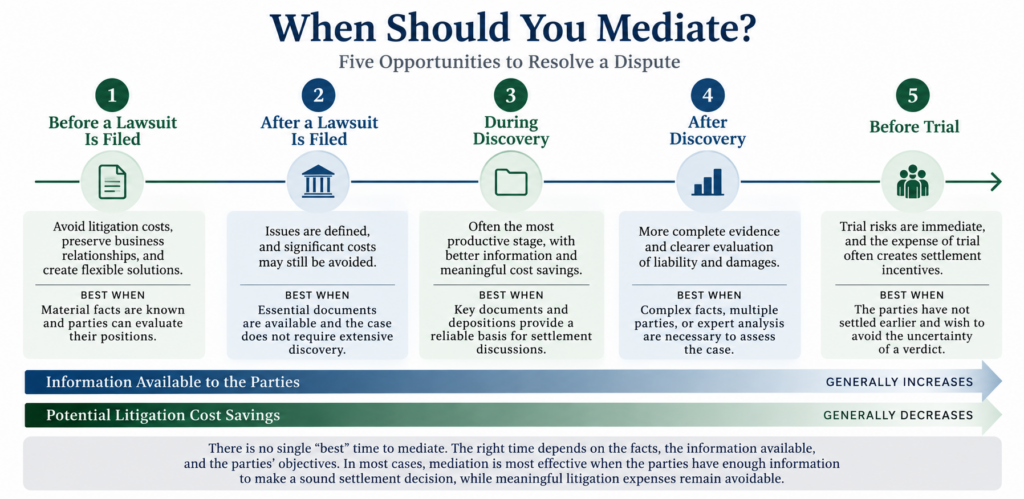
The optimal time to mediate depends on the information available, the complexity of the dispute, and the litigation expenses the parties can still avoid.
3. Mediation During Discovery: Often the Most Productive Stage
For many business disputes, mediation during discovery offers the best balance between informed negotiations and cost savings. By this stage, the parties may have exchanged relevant documents, answered written discovery, and completed several important depositions. The evidence begins to clarify the dispute. Counsel can better assess liability, damages, and witness credibility.
Discovery also exposes weaknesses that the parties may have overlooked. A contemporaneous email may contradict a witness’s recollection. Contract language may undermine a party’s interpretation. Financial records may fail to substantiate claimed damages. Such developments often encourage more realistic settlement positions.
The Value of Targeted Discovery
Attorneys should distinguish between completing discovery and obtaining enough information to evaluate settlement. The former may require months of work. The latter may require only a limited investigation. Consider a dispute involving a terminated construction subcontract. The parties may need the contract, payment records, change orders, project correspondence, and reliable cost-to-complete figures.
They may not need ten depositions. Similarly, an independent valuation may resolve the central disagreement between business partners more effectively than extensive witness testimony. Counsel should identify the issues that materially affect settlement value and direct discovery toward those issues. This approach allows the parties to negotiate with greater confidence while preserving the economic advantages of mediation.
The American Bar Association addressed this concern in Early Returns on Early Dispute Resolution. The article discusses how traditional litigation practices often postpone meaningful settlement discussions until the parties have incurred substantial discovery expenses. That approach merits consideration in commercial litigation, where discovery costs can consume a substantial portion of the amount in controversy.
The Risk of Mediating During Discovery
The principal difficulty involves determining whether the parties have obtained sufficient information. One party may consider the case ready for mediation, while the other insists that additional depositions or expert opinions remain essential. Counsel should address those disagreements before scheduling the session. Otherwise, a party may attend without adequate preparation or a genuine willingness to negotiate. An experienced mediator can sometimes help counsel identify the information necessary for productive discussions.
The objective is not exhaustive discovery. It is a sufficiently reliable understanding of the dispute to support an informed settlement decision.
4. Mediation After Discovery: Greater Certainty at a Higher Cost
Some disputes require substantial discovery before the parties can evaluate their claims. Complex commercial litigation may involve extensive financial records, multiple parties, disputed contractual obligations, and competing expert opinions.
For example, litigation arising from alleged financial misrepresentations in the sale of a business may require accounting records, valuation analyses, and expert testimony. In such cases, completing discovery before mediation may serve a legitimate purpose. Counsel can evaluate the evidence, assess witness credibility, and estimate potential trial outcomes with greater confidence. The parties can then develop settlement positions that reflect the strengths and weaknesses of their respective cases.
The disadvantage is expense. By the conclusion of discovery, the parties may have incurred substantial attorney fees, expert expenses, and other litigation costs. Those expenditures constitute sunk costs. They should not determine whether a proposed settlement makes economic sense. Nevertheless, they often influence client expectations. A party that has spent $150,000 pursuing litigation may resist a settlement it would have accepted months earlier. Litigation also tends to entrench positions. As the dispute progresses, parties may become increasingly committed to their claims or defenses. Thus, completing discovery may improve the parties’ understanding of the case while diminishing their willingness to compromise.
Counsel should weigh the value of additional information against the expense and delay necessary to obtain it.
5. Mediation Before Trial: When Litigation Risks Become Immediate
Many cases settle shortly before trial. By that point, counsel has developed the evidence, identified anticipated testimony, and evaluated the legal issues. The parties also face the immediate prospect of trial expenses and an uncertain verdict. A firm trial date often creates settlement incentives that did not exist earlier.
Corporate representatives must consider the consequences of an adverse judgment. Business owners face the disruption of attending trial. Counsel must account for additional preparation expenses, expert testimony, and potential appellate proceedings. These considerations can make pretrial mediation particularly effective.
The Disadvantage: Lost Opportunities for Savings
The principal disadvantage is that the parties have already incurred substantial litigation expenses. They may have completed discovery, retained experts, litigated dispositive motions, and devoted considerable resources to trial preparation. Settlement can still avoid trial costs and eliminate the uncertainty of a verdict. It may represent the most prudent resolution. Nevertheless, the parties might have achieved a comparable result months earlier at considerably less expense. Pretrial mediation remains valuable, but counsel should not automatically treat it as the preferred time to negotiate.
6. Mediation After Trial or During an Appeal
Mediation can remain useful even after a verdict or judgment. An appeal introduces additional expense, delay, and uncertainty. The prevailing party may also encounter difficulties collecting or enforcing the judgment. Post-trial mediation can address appellate risk, payment arrangements, judgment enforcement, and other unresolved matters. A verdict, however, may alter the parties’ negotiating positions.
The prevailing party may have little incentive to compromise. The losing party may regard an appeal as its only remaining opportunity for relief. Although post-trial mediation cannot recover the expenses already incurred, it can bring finality and avoid further proceedings.
7. An Unsuccessful Mediation May Still Advance Settlement
Mediation need not occur only once.
An initial session may identify the issues preventing settlement, even when the parties cannot reach an agreement. For example, the parties may agree on liability but disagree about damages. They may need an independent valuation, an expert opinion, or testimony from a critical witness. Once they obtain that information, further mediation may prove productive.
The first session may also narrow the dispute and reduce the scope of subsequent discovery. A second mediation can then focus on the remaining issues. Counsel should not automatically regard an unsuccessful mediation as a wasted effort. Its value may extend beyond an immediate settlement. The relevant question is whether the process advances the parties toward a reasonable resolution.
8. The Mediator’s Experience May Influence the Timing
The mediator’s qualifications can affect whether early mediation makes sense.
A mediator familiar with the underlying subject matter can often identify disputed issues, assess competing positions, and facilitate negotiations without extensive preliminary explanation. In construction litigation, for example, familiarity with payment applications, change orders, scheduling disputes, backcharges, and cost-to-complete calculations can prove valuable. The same principle applies to disputes involving business ownership, employment, real estate, and commercial contracts. Subject-matter expertise does not eliminate the need for evidence. Nor does it change the mediator’s responsibility to remain neutral.
It can, however, reduce the time necessary to understand the dispute and identify potential grounds for settlement. The Georgia Center for Arbitration & Mediation provides access to neutrals with experience across a range of legal and commercial matters.
GCAAM also offers online mediation services, which can reduce travel expenses and accommodate parties, counsel, and decision-makers in different jurisdictions.
9. A Practical Approach to Scheduling Mediation
Before scheduling mediation, counsel should consider several questions:
First, do the parties understand the material facts? If not, what additional information do they need?
Second, can they reasonably estimate damages and potential exposure?
Third, would additional discovery materially change the settlement analysis?
Fourth, what litigation expenses can the parties still avoid?
Finally, are the parties prepared to negotiate, and will the necessary decision-makers participate with adequate settlement authority?
These considerations should guide the decision.
Assume, for example, that a commercial dispute has a reasonable settlement range of approximately $200,000. The parties anticipate another $100,000 in combined litigation expenses before trial. If additional discovery is unlikely to change their evaluation materially, early mediation may offer substantial economic advantages. Conversely, if a critical deposition or expert report could significantly affect liability or damages, postponing mediation may be prudent. Counsel must assess both litigation risk and the value of additional information.
A deposition that costs $8,000 may prove worthwhile if its testimony could materially change the settlement evaluation of a $1 million dispute. The same deposition may offer little economic value in a straightforward $75,000 contract case where the parties already possess the essential documents.
The relevant inquiry is whether the anticipated benefit of additional information justifies its cost.
Mediation should form part of the litigation strategy, not merely occupy a place on the calendar.
Conclusion: Mediate When the Parties Know Enough to Settle
No single stage of litigation offers the best opportunity for mediation in every case.
Pre-litigation mediation may avoid substantial expense and preserve commercial relationships. Mediation during discovery often provides an effective balance between reliable information and cost savings. Post-discovery and pretrial mediation may prove necessary when the parties cannot evaluate liability or damages earlier.
In most business disputes, however, counsel gains little by postponing mediation merely to complete discovery. The central question is whether additional litigation will produce information or leverage sufficient to justify its cost. Effective trial lawyers prepare their cases for trial while continually evaluating settlement opportunities. These responsibilities complement one another.
The best time to mediate is when the parties possess enough information to make a sound settlement decision, while meaningful litigation expenses remain avoidable.
Mediation Services Throughout Georgia
The Georgia Center for Arbitration & Mediation (GCAAM) assists attorneys, businesses, and individuals in resolving civil and commercial disputes through mediation and arbitration.
With offices in Atlanta and Thomasville, Georgia, virtual mediation services, and neutrals willing to travel, GCAAM serves parties throughout Georgia and beyond.
Whether a dispute is in its preliminary stages or approaching trial, GCAAM can help the parties arrange mediation with a neutral who understands the relevant subject matter.
Visit www.gcaam.com to learn more about our services or inquire about scheduling a mediation.
Disclaimer: This article provides general information and does not constitute legal advice. The appropriate timing of mediation depends on the circumstances of the dispute, applicable law, and the advice of counsel.